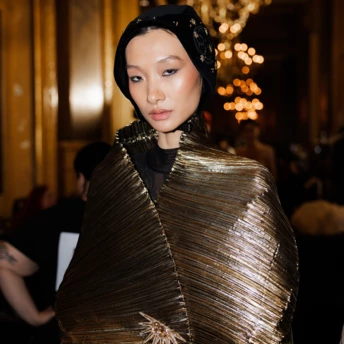
What Ines Kaldas Knows That Fashion Is Still Learning
Ines Kaldas came to modeling by an unusual route. With a background in neurobiology and a practice in abstract painting, she entered fashion with an already developed fascination with the body, color, form, and the ways an inner state becomes visible. Enthusiastic about posing, Kaldas approaches modeling and editorial shoots through her particular sensitivity to color and shape, which she describes as experiencing them as a sense of physical wellbeing.

Promotion
These might seem like unrelated pursuits until you hear her talk about modeling. Then they begin to look suspiciously like preparation. "Never have I burnt for anything as much as for the kind of modeling that serves the very aspects of the art of fashion where it intersects with and seeks to express emotions and the human condition," she says.
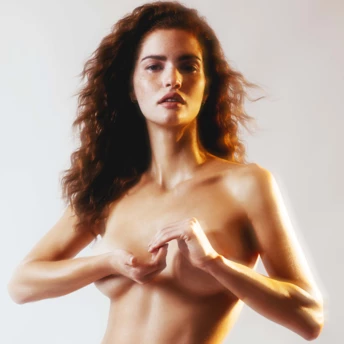
Her shorter version is even better: "painting with poses, gestures, and emotions." That is more or less the premise of her latest editorial, photographed by Paolo Guadagnin, with creative direction and styling by Luigi Nisi and hair and makeup by Rossano Fasano. There are three colors: black, white, and red. The reference is Saint Laurent. More specifically, it is the Saint Laurent woman, whom Kaldas describes as "elegant and classy – but also strong." It would be easy to stop there. Beautiful woman, beautiful clothes, Saint Laurent, a little severity. Fashion has survived on less. Kaldas, however, is interested in what happens underneath the clothes.
Getting Into the Frame
Kaldas’s background in neurobiology has made her attentive to the distance, or lack of it, between what happens in the mind and what happens in the body. "My brain is not the same before and after I write this, before and after a conversation, before and after a photo-shoot," she says.
For Kaldas, this is not merely an interesting scientific fact. It has consequences in front of a camera. Thoughts produce reactions. Emotions alter the body. The body enters the frame. The camera, inconveniently, sees quite a lot. Recognizing this, and drawing on her knowledge of the neurobiology of perception, gives Kaldas a way to regulate emotions and focus on the present.

That mattered when she first stepped in front of Guadagnin’s camera. "When I finally had his camera pointed at me, it was a shaking moment. So, it took me a while to focus my consciousness again on the Now, on this for me so special occasion." Then something clicked. Space, gesture, and form became "all pure feeling." Kaldas takes technique seriously. The interesting part begins when technique becomes instinct.
A Feeling for Form
Long before there was modeling, there was color. One of Kaldas’s earliest memories of experiencing it differently comes from school. Asked to write an essay about a painting, she enthusiastically described "cynical and jealous yellow." She liked the phrase. Her teacher did not. The essay received a poor grade for being "out of line."
Around 2018, Kaldas began painting. Abstract work came more naturally to her than figurative painting, and she became increasingly aware of how instinctively she responded not only to colors and forms but to the relationships between them. Empty space mattered too. "When I paint, I do not think – the colors tell me where they go on the canvas, it is a clear feeling, no other options," she says. She deliberately avoided formal art training. She wanted to discover where that instinct would take her without imposing somebody else’s system on it.
With modeling, interestingly, she did the opposite. Kaldas studied posing, acting for models, and runway technique. She wanted the grammar before she started playing with the syntax. Only then did she begin bringing the instincts she had developed through painting into fashion photography. She describes the aim as learning to "inhabit silhouettes."
"My emotions as well as the underlying frame of mind serve to embody structured garments with posture and attitude," she says. "In the end, I hope I can thereby truthfully serve the embodiment of whatever the shoot envisions." During a shoot, color, space, clothing, emotion, and the body become part of the same composition. Kaldas calls it "painting with poses, gestures, and emotions." Later, looking at the photographs, she reads posture, expression, gesture, and color almost as she might read elements on a canvas. The individual image matters. So does what happens between images.
Strength and Vulnerability
The story Kaldas sees in this editorial begins with strength. For the first look, Nisi chose a long black Tom Ford dress. Kaldas describes it as sexy but also "severe," which is a much more interesting adjective. The rectangular earrings suggested a similarly severe expression. Her hands and arms could do something else: soften the geometry, introduce movement, complicate the picture. These images, Kaldas says, represent "a feminine version of strengths."

Then the editorial shifts. A blurred photograph acts as a hinge. The black Tom Ford dress gives way to a white Saint Laurent shirt. Strength gives way to vulnerability. In one image, Kaldas is photographed from behind. This matters to her because it removes the most obvious instrument a model has for directing an image: her face.
"To photograph the model from behind means she has no chance to influence the mood of the image, or how she comes across, through expressed emotion in any way!" she says. "Therefore, this is a pure, uninfluenced, vulnerable depiction of body posture – as expression of mental posture."

When Guadagnin asks her to turn around, she keeps the vulnerability rather than resetting for the camera. The resulting portrait becomes a counterpart to the photograph from behind. Even the palette participates in the argument. "What unifies the images of this editorial is the color-palette in black&white. It is just like life, black and white, good and bad, strong and vulnerable. Nevertheless, just as in life, there is the occasional red pinnacle." Black, white, and one interruption. It is a neat visual system for a story that is really about contradictions.
The Saint Laurent Woman
The editorial borrows from Yves Saint Laurent, but not in the museum-piece sense. Nobody is trying to reconstruct a decade. What interests Kaldas is the woman inside the Saint Laurent mythology: elegant, controlled, sensual, intelligent, slightly severe. A woman whose clothes announce her presence without doing all the work for her.

Kaldas identifies strongly with the Yves Saint Laurent sentiment: "Without elegance of the heart, there is no elegance." Her own taste is broad. She loves the sleek femininity of the interwar period and the long line of a bias-cut dress. She owns an original period dress found years ago in a San Francisco vintage store.
In Her Own Time
Fashion has recently become much more enthusiastic about mature models. Kaldas admires the individuality and complexity of "best-ager models," as she calls them. She is considerably less interested in making "mature model" the aspect that identifies her or behaving like one.

"I am somewhat of an existential rebel," she says. "I do not believe in linear time." Kaldas’s point is actually quite concrete. Not denying time, she objects to the instructions that tend to arrive with it. "As I freely accept who and what I am, at the same time, I consciously decided that I would not subscribe to any expectations based on chronological age!" she says. "I am simply living my authentic self. I am trying to grow into my best version. And, unlike in prior times, I am clear on what this best version of myself does look like."
Fashion has always had a complicated relationship with time. It worships the new, periodically rediscovers the old. Kaldas is interested in another possibility. Time can mean accumulation rather than subtraction. More experience. More references. More certainty. Less willingness to organize oneself around somebody else’s expectations. "I am my kind of youthful, my kind of being increasingly free and confident, my kind of courageous and adventurous," she says. "I live this authentically each and every day without having to think about it. There is no doubt about this in my mind whatsoever." The important phrase there may not be "youthful." It may be "my kind."
On Her Own Terms
Kaldas talks frequently about grace, although not as a synonym for prettiness. "Grace observed and grace attempted is what keeps me going, helps me to anchor myself inwardly, and is the basis why I never give up." Her fashion references suggest a similar appetite for complexity. There is Anthony Vaccarello at Saint Laurent, Matthieu Blazy at Chanel, Jonathan Anderson, Steve O Smith, Robert Wun, Schiaparelli, Maison Margiela, and Iris van Herpen. And then there is Rick Owens.

"A long wish of mine, I would just be beyond thrilled if I found myself having a chance at an adventurous foray into Rick Owens’ world!" she says. It is not difficult to see the attraction. Kaldas gravitates toward fashion that treats the body as more than a convenient place to hang a dress. She is interested in clothes that alter proportion, disturb expectations, create characters, or ask questions.
Which brings us back to the body. Kaldas began with neurobiology. Then came painting. Then modeling. They sound like separate chapters until you notice that she is asking essentially the same question in each of them: how does an internal experience acquire a visible form? A painter has color and space. A designer has fabric and silhouette. A model has a body.
Sometimes the answer is in the face. Sometimes it is in the hand, the shoulder, the particular angle of a spine. Turn the model around and take away her expression, and the posture has to confess on its own. For Kaldas, this is where everything meets: neurobiology, painting, fashion, color, form, emotion, and the body in front of the camera. Eventually, all of it has to enter the frame.

Photographer: Paolo Guadagnin, @paologuadagninstudio
Creative director & Stylist: Luigi Nisi, @lu_nisi
Hair & Makeup: Rossano Fasano, @rossanofasano
Model: Ines Kaldas, @ines_kaldas